 Abkhazia
 Albania
 Algeria
 Andorra
 Argentina
 Armenia
 Australia
 Austria
 Azerbaijan
 Bahamas
 Bahrain
 Bangladesh
 Belarus
 Belgium
 Bolivia
 Bosnia and Herzegovina
 Brazil
 Bulgaria
 Cambodia
 Cameroon
 Canada
 Chile
Chile
 China
China
 Colombia
 Congo
Congo
 Costa Rica
 Croatia
 Cyprus
 Czech Republic
 Denmark
 Ecuador
 Egypt
Egypt
 El Salvador
 Estonia
 Finland
 France
 Georgia
 Germany
 Ghana
Ghana
 Greece
 Guatemala
 Hong Kong
 Hungary
 Iceland
 India
India
 Indonesia
 Iran
Iran
 Iraq
Iraq
 Ireland
 Isle of Man
 Israel
 Italy
Italy
 Japan
Japan
 Jordan
 Kazakhstan
 Kenya
Kenya
 Kosovo
 Kuwait
 Kyrgyzstan
 Laos
Laos
 Latvia
 Lebanon
 Liechtenstein
 Lithuania
 Luxembourg
 Macau
Macau
 Malaysia
 Malta
Malta
 Mauritius
 Mexico
 Moldova
 Mongolia
 Morocco
 Myanmar
 Nepal
Nepal
 Netherlands
 New Zealand
 Nigeria
 North Macedonia
 Norway
 Oman
Oman
 Pakistan
 Panama
 Paraguay
 Peru
Peru
 Philippines
 Poland
 Portugal
 Puerto Rico
 Qatar
Qatar
 Romania
 Russia
 Saudi Arabia
 Scotland
 Serbia
 Singapore
 Slovakia
 Slovenia
 South Africa
 South Korea
 Spain
Spain
 Sweden
 Switzerland
 Taiwan
 Thailand
 Tunisia
 Turkey
 UAE
UAE
 USA
USA
 Ukraine
 United Kingdom
 Uruguay
 Uzbekistan
 Venezuela
 Vietnam
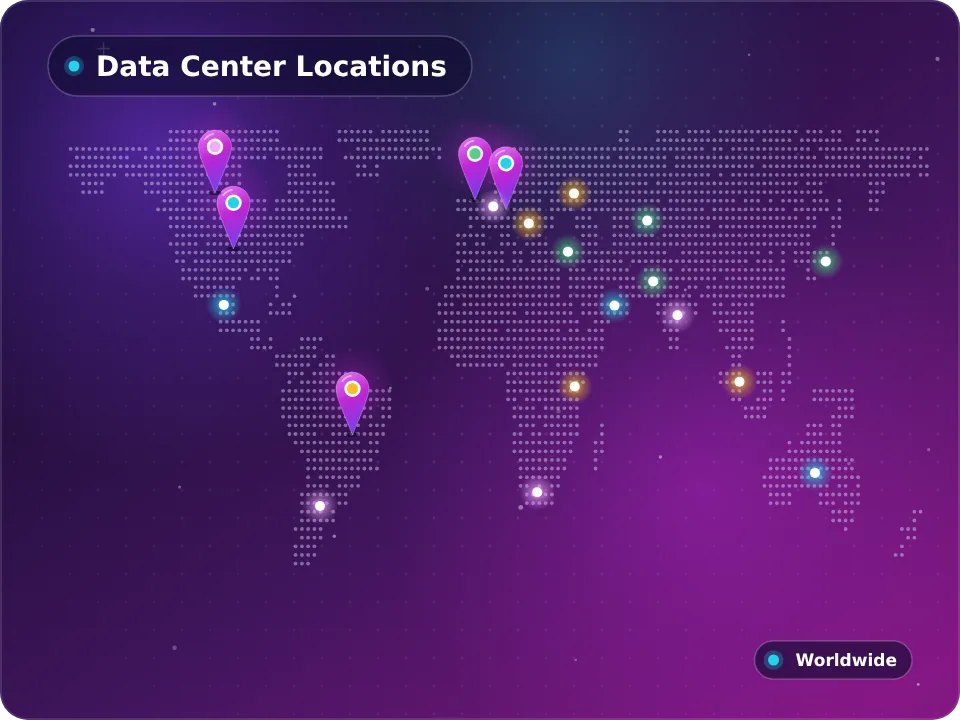
A Worldwide Map of Hosting Facilities Under One Account
Few hosting providers offer facilities in as many corners of the world as we do. Organizations use our server hosting for remote storage, processing and distribution of large amounts of data, and individuals use it for websites, game servers, VPNs and development work. Either way, the starting point is the same question: which data center should my server live in?
Every facility we work with is equipped with the infrastructure a serious hosting operation needs: power distribution with supplemental power subsystems and electrical switching, uninterruptible power supplies, backup generators, ventilation and cooling systems such as computer room air conditioners, and provision for multiple network carriers.
This page brings those locations together. The grid below lists each country and city, grouped by product, so you can see at a glance where VPS, dedicated servers and shared hosting are available. Each entry links to its own page with plans, prices and test IP addresses.
The locations cover three kinds of service. Shared hosting suits websites and email that do not need server-level control. Virtual private servers give you root access and guaranteed resources at a modest price. Dedicated servers hand you a whole physical machine for heavy or sensitive workloads. Each one has its own set of facilities, and the grid lets you filter by the product you need.
The goal is to let you focus on your core business rather than on running hosting infrastructure and fixing hardware problems. Choose a location, order the service, and benefit from our network, services and cost savings while we handle the facilities.
Power, Cooling and Carrier Infrastructure in Our Facilities
A server is only as reliable as the building it sits in. Power is the first requirement: each facility we use has utility power distribution backed by uninterruptible power supplies that carry the load for the seconds or minutes needed for backup generators to start. Electrical switching gear moves the load between sources without dropping the servers.
Cooling is the second. Servers turn almost all the electricity they consume into heat, and racks packed with processors and drives need constant airflow and temperature control. Computer room air conditioning and ventilation systems keep hardware within safe operating ranges, which protects both performance and component life.
Connectivity is the third. A data center that relies on a single internet provider is exposed to that provider's outages and routing choices. The facilities we choose are provisioned for multiple network carriers, so traffic has more than one route in and out and can follow a more direct path to different networks.
These three pillars are the reason a server in a professional data center outperforms one in an office or home. They are also what we check first when evaluating a new location for our network.
When you read a location page, these are the details worth checking: whether the facility has generator backup, how many carriers feed it, and which data-center city it is in. Two data centers in the same country can perform very differently for your users depending on their connectivity.
How We Select Each Partner Data Center
We think in terms of long-term relationships with new and existing clients, and that shapes how we choose facilities. A data center joins our network only if it is capable of supporting a high level of hosting service: good hardware, dependable power and cooling, quality switches, reputable internet providers, fast connections and, above all, responsive and cooperative management.
That last point matters more than it might seem. When a server needs a hardware swap, a remote reboot or a network investigation, the speed and competence of the on-site team decide how quickly the issue is resolved. A facility with excellent equipment but slow staff is not one we want to depend on.
In many smaller markets, there are only a handful of facilities to choose from. There, we compare what is available and pick the option that offers the best balance of connectivity, stability and price for that country. In major hubs with dozens of choices, we can be more selective.
The tier class and facility details vary from site to site, so each location page states the information that applies to that specific data center, rather than making one blanket claim for the whole network.
We also revisit locations over time. If a facility's service quality drops or a better-connected option appears in the same market, we adjust the offer rather than keep selling a weaker site out of habit.
Physical and Network Security Across Our Locations
No piece of hardware is immune to failure, and we are honest about that. What we can control is how carefully your data is protected. Across our facilities, that starts with data-center-level firewalls and other basic network precautions that filter obvious attack traffic before it reaches customer machines.
Physical security sits underneath. Data centers restrict who can enter the building and the server rooms, so the machines holding your data are protected against tampering and theft, not only against remote attacks.
Some of our locations include more advanced protection: next-generation firewalls, intrusion prevention, web application security, DDoS mitigation and malware and virus prevention. Where these are not part of the base service, they can be added.
You are free to strengthen your setup further with add-ons such as external firewall software, backup services and DDoS mitigation. A sensible baseline for any server is a host-level firewall that only opens the ports you use, key-based SSH logins, automatic security updates and a regular backup stored in a different location from the server itself.
Security on shared hosting is handled for you at the server level, while on VPS and dedicated servers the operating system is yours to secure. Knowing where that line sits for your product helps you plan the right protection from day one.
VPS Data Centers in More Than 100 Countries
Virtual private servers have the broadest reach of all our products. In Europe, coverage runs from the UK, Ireland and Iceland through Germany, the Netherlands and France to the Baltic states, the Balkans, Ukraine and Moldova. Smaller jurisdictions such as Liechtenstein, Luxembourg, Malta, Andorra and the Isle of Man are on the list too.
The Middle East and Central Asia are well represented, with locations including the UAE, Saudi Arabia, Qatar, Oman, Kuwait, Bahrain, Jordan, Israel, Iraq, Kazakhstan, Uzbekistan and Kyrgyzstan. In South and East Asia there are VPS data centers in Pakistan, India, Bangladesh, Nepal, Japan, South Korea, Hong Kong, Taiwan, Singapore, Vietnam, Cambodia, Laos and Mongolia, among others.
Africa and the Americas complete the picture. African locations include South Africa, Nigeria, Kenya, Ghana, Egypt, Morocco, Tunisia and Mauritius. In the Americas, you will find the USA, Canada, Mexico, Brazil, Argentina, Chile, Colombia, Peru, Panama, Costa Rica and the Bahamas, plus several more.
Each country page lists its data-center cities, plans and test IPs. The full catalog is on our VPS hosting page, and many countries offer more than one facility to choose from.
Prices and specs differ by location because local power, bandwidth and hardware costs differ. A VPS in a major European hub is often cheaper than one in a small island territory, simply because connectivity costs more there. The country page always shows the current numbers.
Dedicated Server Facilities by Country
Dedicated servers need physical hardware sitting in a rack, so they are offered from a more focused set of locations. Current dedicated server countries include the Netherlands, Sweden, Hungary, Russia, Ukraine, Belarus, Turkey, Georgia, the Isle of Man, the UAE, Saudi Arabia, Iraq and Egypt.
In Asia-Pacific, dedicated hardware is available in Pakistan, Bangladesh, Hong Kong, Japan, South Korea, Malaysia, Indonesia, Australia and New Zealand. In the Americas, there are dedicated servers in Brazil, Argentina and Chile, and in Africa in South Africa.
That mix is deliberate. Alongside well-connected hubs, it includes markets where local bare-metal hosting is hard to find, such as Iraq, Bangladesh or Georgia. For businesses that need a full machine inside one of those countries, local hardware avoids the latency penalty of serving the market from a distant hub.
Specifications, delivery times and stock vary by location, because each country's hardware supply is different. Our dedicated server overview lists every country with its available configurations, so you can compare processors, memory, storage and network ports before ordering.
If the country you need is not on the dedicated list, a high-spec VPS in the same market is often a practical substitute, or a dedicated machine in the nearest neighboring country with good connectivity.
Matching a Data Center to Latency and Audience
The best data center for your project is usually the one closest to the people using it. Each extra thousand kilometers of fiber adds delay, and routes are rarely straight lines. For a website, that means slower page loads; for a game or VoIP service, it means lag that users notice immediately.
Start by identifying where most of your traffic comes from, using your analytics or server logs. Then test the candidate locations. Each location page lists a test IP address, and our network and IP ping page helps you compare response times from your own connection.
Remember to test from your users' side, not only from your office. A data center that looks fast from Europe may be slow from the Gulf if traffic takes a long detour. Ask a colleague or a customer in your target country to run a few pings, or use a remote test server.
When your audience is spread across several regions, consider more than one location: a primary server in your largest market and smaller ones elsewhere. Our wide coverage makes this possible without juggling multiple providers.
Keep an eye on stability over time, not just a one-off test. Running a ping for a few minutes at your audience's peak hours gives a far better picture than a single reading taken at a quiet moment.
Territory-Specific Hosting for VPN, Retail and Testing
Many of the data centers we offer are genuinely unusual. People who need to be online from a particular part of the world, whether to sell goods locally, research how websites behave in a specific country, run VPN services or carry out other territory-specific work, often find no provider that hosts there. Filling those gaps at an economical price is one of our strengths.
A local IP address changes how websites, search engines and streaming services see your traffic. Marketers use servers in different countries to check localized search results and ads. Developers test geo-targeted features. VPN and proxy operators offer exit points in places their competitors cannot.
Data locality matters for some businesses too. Organizations that prefer to keep customer data inside a particular country can choose a facility within its borders instead of relying on a regional hub abroad.
Whatever the reason, the process is the same: pick the country, check the data-center city and test IP, choose a plan, and deploy. Most locations offer a wide choice of operating systems and versions, so your standard setup can follow you from one territory to the next.
For legal and policy reasons, usage must still follow our terms of service and the laws of the country where the server sits, which can differ from your own. Read the location page notes before deploying anything sensitive.